In early October Marcello Ascani, one of Italy's biggest business YouTubers, published an interview with Davide Dattoli, founder of Talent Garden, the European network of tech campuses, about how he uses AI day to day. It passed 160,000 views within a week, and the companies we work with were sending it to us before we'd even watched it.
The setup Dattoli describes rests on three tools: Notion as memory, Fireflies to transcribe and analyse calls, and Hermes Agent orchestrating twenty-five agents that pass information to each other in a shared chat, the way a team would. On top of that runs some very concrete work: sales offers drafted automatically after a meeting, and a system that reviews every sales conversation and sends feedback to the rep and their manager.
It's worth taking apart, because it is one of the clearest descriptions around of a second brain that does work rather than store notes. And because between one person's system and a company's there is a layer of engineering that, reasonably enough, a video doesn't show.
From personal second brain to company second brain
The phrase comes from Tiago Forte's Building a Second Brain (2022): a method for capturing and organising notes so you can find them when you need them. It is built for one person, and it runs on Notion, Obsidian or a paper notebook.
A company second brain differs in three ways, and everything else follows from them.
It acts. It doesn't just help you find a document: it writes to the CRM, drafts a proposal, opens a task.
It has many users. The rep in Milan shouldn't read the CFO's notes, and an agent answering the rep shouldn't be able to use them either.
It has many sources. Knowledge lives in the ERP, the CRM, email, shared drives, and now in calls too.
The four parts
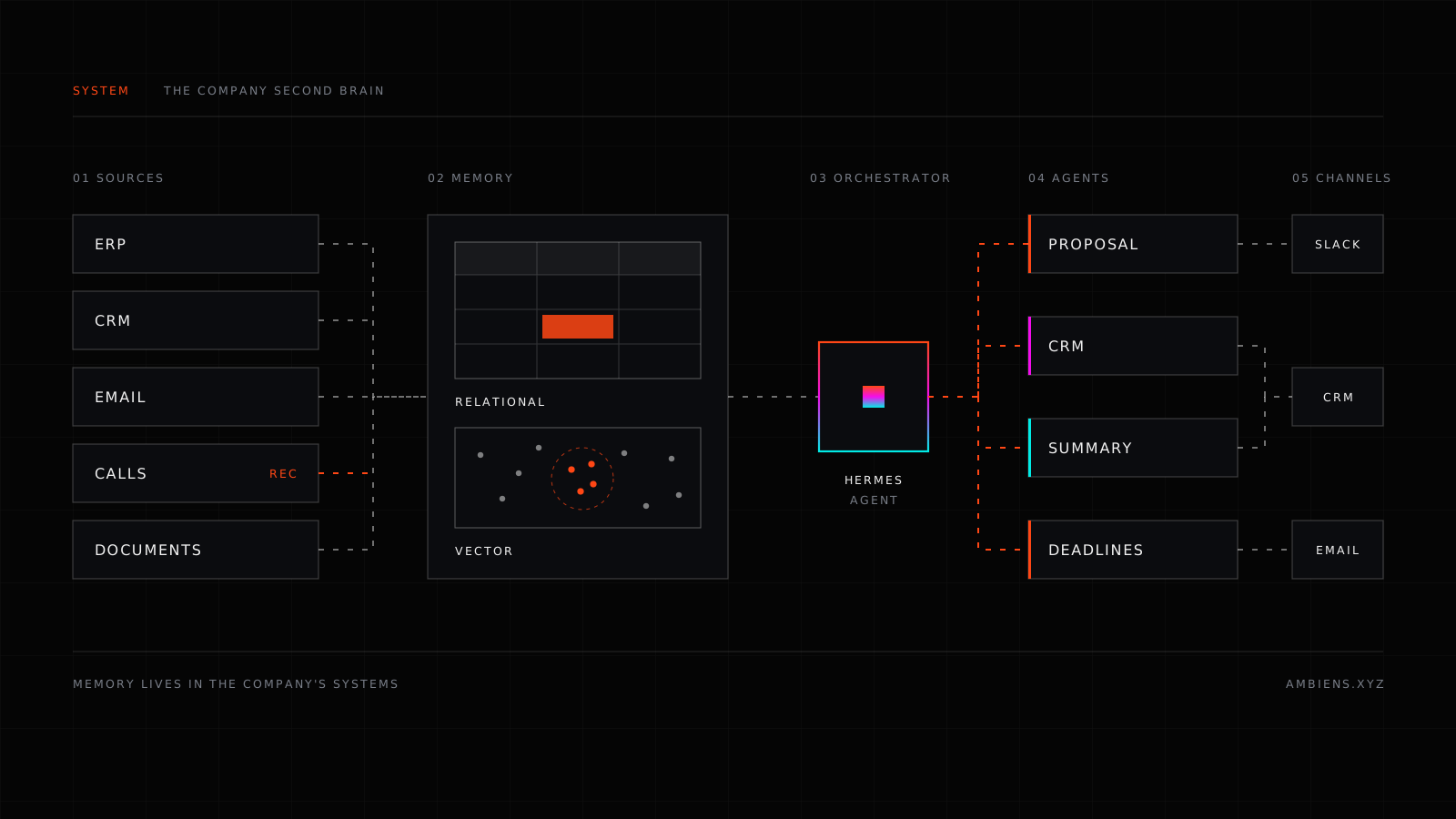
Memory: two databases, not one
Dattoli makes the point in a line that's worth the whole interview: having two databases, one relational and one vector, is essential today. The reason is that the questions people ask a company come in two kinds.
How many orders did this customer place in 2025, and at what average discount? is an exact question. It has one answer, it lives in a table, and a query resolves it. A language model that tries to answer by reading documents will get it wrong, confidently.
What has this customer said about timelines in the last three calls? is a question about meaning. The answer is scattered across transcripts and emails, phrased differently every time. That needs vector search: text is split into chunks, each chunk becomes a vector (an embedding), and the system retrieves the chunks closest to the question. This is retrieval-augmented generation, RAG.
The two databases can be a single one. PostgreSQL with the pgvector extension keeps tables and vectors side by side, and is often the easiest option to maintain. What matters is keeping the two kinds of question apart; the server count is a detail.
Calls as a source
This is the part of the video that lands hardest, and it is also the richest source. A forty-minute call holds objections, budgets, deadlines and names, most of which reach the CRM, at best, as two hurried lines.
The chain is transcription, speaker separation (diarization), summary, then extraction of structured fields. Fireflies does it as a service. The same chain can run on a model hosted in-house when calls must not leave the company. Either way, participants need to be told before recording starts, and under GDPR in Europe that notice is not optional.
Agents: one job each
An agent is a language model with tools and a goal. The systems that hold up use small agents: one drafts the offer, one updates the CRM opportunity, one watches deadlines. Dattoli's twenty-five agents are best read that way: twenty-five jobs, each with its own boundaries.
Connecting them to company systems now has a standard, the Model Context Protocol (MCP), introduced by Anthropic in late 2024. An MCP server exposes the CRM or the ERP as a set of tools any compatible agent can use, so the connector gets written once.
Orchestrator: what Hermes Agent does
Hermes Agent is an open-source agent from Nous Research, released under the MIT licence. From its documentation:
- it keeps a persistent memory curated by the agent itself, in plain text files (
MEMORY.mdfor what it learns about its environment,USER.mdfor the preferences of the person using it), and can search past conversations; - after a complex task it writes its own skill, a reusable procedure in the open agentskills.io format, and refines it with use;
- it can spawn isolated subagents for parallel work, which is where it acts as an orchestrator;
- it connects to any MCP server and ships with more than forty tools of its own;
- it talks through a single gateway on Slack, Telegram, WhatsApp, Signal, Discord and email;
- it works with any model, through OpenRouter, OpenAI or a custom endpoint;
- it is self-hosted: the docs suggest a five-dollar VPS is enough.
One distinction is worth keeping clear. Hermes's memory is the agent's memory: its notes on how to work, who it talks to, what it has already tried. It is not the company's knowledge base. That stays in the memory described above, and Hermes reaches it through tools. Anyone who tries to use MEMORY.md as a corporate knowledge base soon finds it's a notebook designed to sit inside the model's context. An archive you can query is a different thing.
Where it breaks
A personal system forgives a lot, because its owner knows what went in. Once there are fifty users, four problems appear that a video won't show you.
Two truths. If the offer sits in a folder and the updated price lives in the ERP, vector search returns the wrong version as confidently as the right one. Every piece of data needs a declared source of truth, and retrieval needs to know which one wins.
Permissions. Access control has to apply at the moment chunks are retrieved. An agent that has already read a confidential document can quote it to someone who shouldn't see it, even if the interface then hides the source.
Instructions hidden in the data. An agent that reads email and can write to the CRM can receive a message crafted to give it orders. This is prompt injection, and it's why agents that read external content shouldn't hold broad write permissions, and why actions with consequences go through a human confirmation.
Measurement. The feeling that the system works arrives early, and on its own it proves nothing. You need a baseline, for example the hours it takes today to prepare an offer, and the same number measured three months later.
The part to build first
In the projects we've seen start well, the first part built was the memory. An agent with no access to what the company knows is a chatbot with a few extra tools, and it answers in generalities because it knows nothing specific. A well-built memory, with the right sources and the right permissions, makes even the simplest agent useful, and the next ones can be added one at a time.
Read carefully, Dattoli's setup says the same thing: twenty-five agents work because underneath there's an archive kept in order, with calls transcribed and notes in one place. It's the least impressive part to show on video, and the one that takes longest to get right.
We build agents and memory inside the systems companies already use. If you want to work out which process to start from, get in touch.
Sources: Marcello Ascani with Davide Dattoli, Come Automatizzare il Lavoro e la Vita con l'AI (Italian) · Hermes Agent, Nous Research (GitHub) · Model Context Protocol · pgvector · Tiago Forte, Building a Second Brain, Atria Books, 2022