The problem
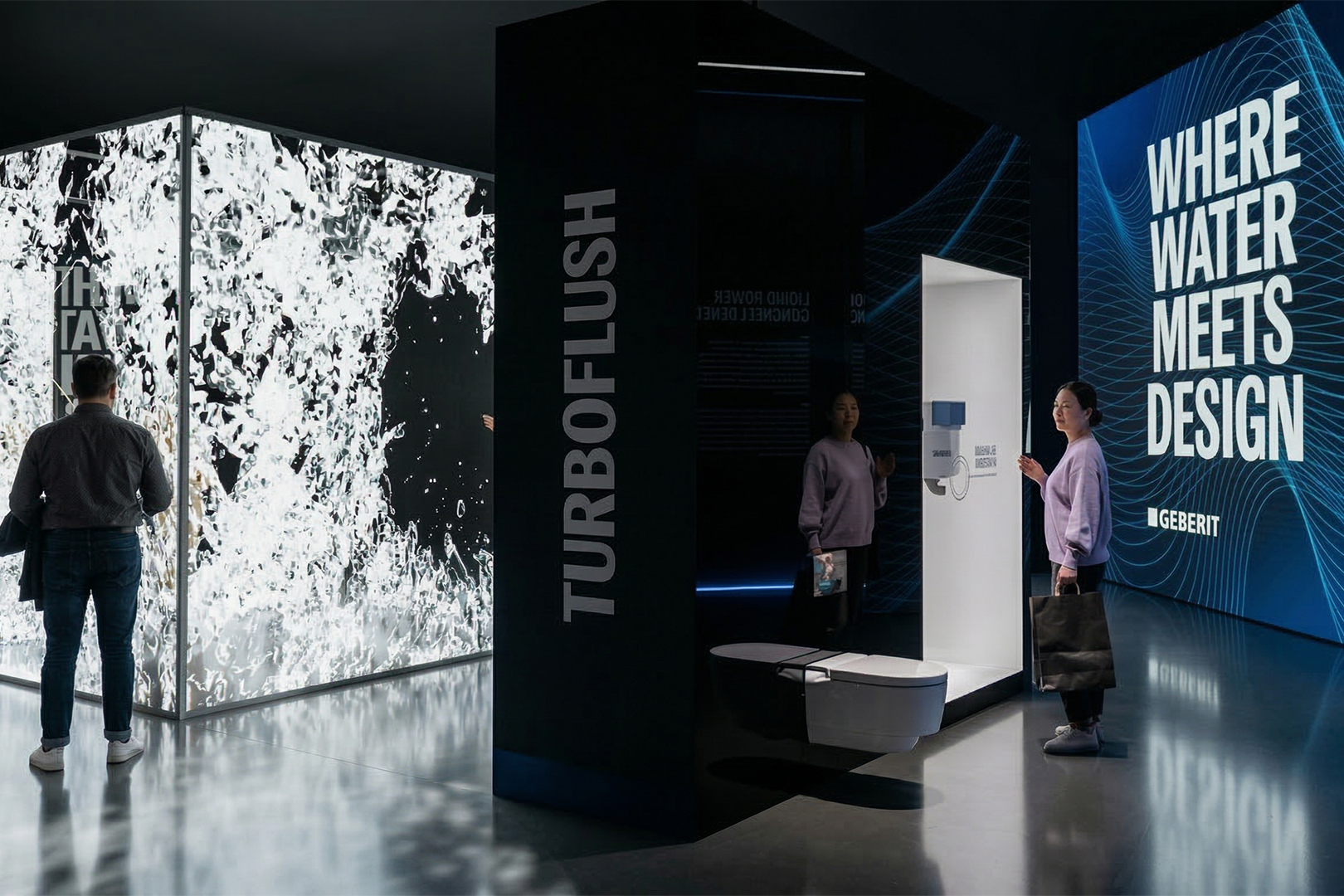
At Salone del Mobile every stand shouts for attention, and Geberit had to get noticed with bathroom products that are, by nature, technical and unspectacular: concealed cisterns, mechanisms, ceramics. A printed panel disappears in that setting. Geberit wanted people to stop, touch something and leave having understood both the design and the engineering of the products.
What we did
Two formats that complement each other: photorealistic 3D videos to tell the story, and a Holobox to explore.
The videos are rendered in Blender Cycles with physically based materials and fluid simulations for the water-flow scenes. Film-style shots open up internal mechanisms, show the grain of the materials, reassemble the parts. Each video tells one product's story (the precision of a concealed cistern, the ceramic of a surface) and works both on the big screens at the stand and cut down for social media.
The Holobox is a glass case in which the product appears to float in mid-air and slowly rotate. It is in fact a Unity HDRP application on a touchscreen PC, a semi-transparent panel and lighting calibrated for the illusion. The visitor touches the glass and picks a product, rotates it, zooms in, compares finishes and variants, opens the technical specifications.
How it went
The Holobox was one of the most photographed spots on the stand, and the photos travelled on social media well beyond the days of the fair. Having two different reasons to stop, a video to watch and an object to handle, kept people at the stand far longer than a conventional display.