What We Deliver
Raw, cinema-quality 3D data (geometry, textures and reference), structured and named to go straight into your studio pipeline. We capture the data, you process it. We do not deliver closed meshes or proprietary formats. Every deliverable includes calibration references, color charts, scale markers, and full metadata so your artists can pick up exactly where our cameras left off.
Equipment
60-camera photogrammetry rig. Sony a6000 bodies in a custom-built array. Simultaneous capture freezes the subject in a single instant: no motion blur, no drift. Configurable for full-body (crowd digitization in 1–2 seconds per subject) or head-only mode (high-resolution FACS facial capture, 10 expressions in under 20 minutes per actor).
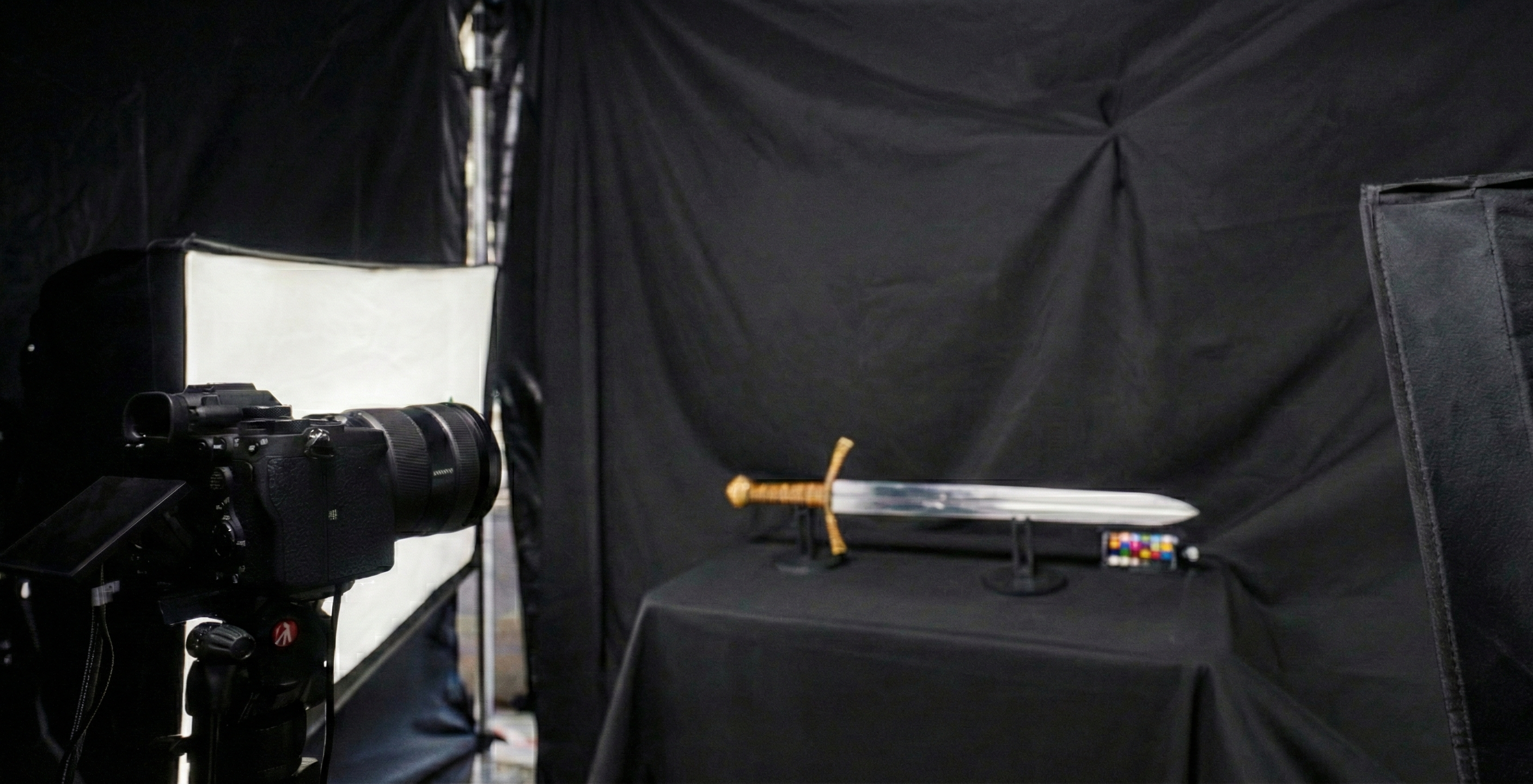
Sony A7R IV (61 MP). Dedicated to cross-polarized texture and look-development reference photography. Paired with circular polarizing filters on lens and Rosco polarizing gels on lights, it separates diffuse albedo from specular response, so your texture artists get clean, lighting-independent color data.
Faro Orbis Mobile Scanner. LiDAR-based spatial capture for environments, interiors, and large-scale set documentation. Millimeter-accurate point clouds with registered color, exportable as E57 or LAS for downstream processing in RealityCapture, Meshroom, or CloudCompare.
Cross-polarization lighting kit. Softbox lights at 6500K daylight temperature with Rosco polarizing filters. Combined with CPL filters on the camera lens, this setup enables parallel-polarized and cross-polarized bracketed capture for separating material properties.
Capture Modes
Props & Set Pieces
Structured light or photogrammetry depending on scale and material. Small to mid-size objects are captured on turntable with controlled lighting, cross-polarized brackets for albedo extraction, and Macbeth color chart in every setup. For each prop we deliver:
- Full orbit RAW photo sets (multiple heights, every angle)
- Cross-polarized brackets (parallel + cross for specular/diffuse separation)
- Scale reference and color calibration in frame
- Slate with asset ID, date, location, photographer
Camera settings follow VFX-industry standard practice: RAW format, manual exposure, f/8 minimum aperture for depth of field, ISO kept below 400, fixed white balance, prime lenses (no wider than 24mm to avoid solve degradation).
Full-Body & Crowd Digitization
The 60-camera rig captures a full 360° in a single synchronized shutter release. Extras step in, hold a scan pose for two seconds, step out. Throughput: 30–50 subjects per day without disrupting the shooting schedule.
Each subject is captured in costume and makeup as they appear on set. Delivered data includes the full photo set from all 60 cameras with calibration, ready for your photogrammetry software of choice.
Facial Capture (FACS)
Head-only rig configuration for lead actors. We capture a standard FACS expression set, typically 10 poses per actor including neutral, brow raises, squints, jaw open, lip funneler, and asymmetric expressions. Session time: approximately 20 minutes per actor.
Texture reference photography is shot first (clean skin, no markers), then alignment dots are placed for facial region tracking if required by your pipeline.
Environment & Set Survey
Faro Orbis for spatial geometry, combined with photogrammetry passes for texture detail. The scanner captures full-color point clouds that integrate with on-set survey data. For exterior locations we combine ground-level photogrammetry with aerial coverage where site conditions allow.
Deliverables include registered point clouds, survey control points, and photographic documentation of the full environment.
Texture & Look-Development Reference
Dedicated capture sessions with the Sony A7R IV in cross-polarization setup. We follow industry-standard procedures:
- 3-shot bracketed exposures at 2-stop intervals for HDR coverage
- Parallel-polarized pass (specular + diffuse) and cross-polarized pass (diffuse only)
- Macbeth ColorChecker and grey/chrome reference spheres in every lighting setup
- 360° rotation on turntable in consistent increments
- Close-up detail passes for surface variation and material transitions
All images delivered in RAW (ARW) with Adobe RGB color space, manual white balance locked per setup.
HDRI Capture
On-set HDRI acquisition for CG lighting reference. Captured with bracketed exposures at multiple stops to cover the full dynamic range of the lighting environment. Delivered as stitched 360° HDR maps ready for your lighting department.
Reference chrome and grey spheres photographed in-situ document the actual lighting conditions for each setup.
On-Set Protocol
When we deploy to a production set, we follow a structured data acquisition protocol aligned with industry standards:
Before the shoot. We coordinate with the VFX supervisor and 1st AD to schedule scan windows that don't conflict with camera. Equipment is pre-rigged and tested.
During capture. Every scan session begins with a slate (date, scene, asset ID, operator) and calibration reference (Macbeth chart, scale marker). Objects remain static throughout capture. Lighting is diffuse and consistent: controlled setups or overcast natural light, never mixed color temperatures.
Quality control. Spot checks on set: focus verification, histogram review, coverage completeness. Issues are caught and re-shot immediately, not discovered in post.
Data management. Cards are ingested on-site, checksummed, and backed up to redundant drives before leaving location. Folder structure is locked before the first shot.
Delivery Structure
All data is organized in a consistent folder hierarchy designed for pipeline ingestion:
[YYMMDD]_[ProjectCode]/
  assets/
    [YYYY_MM_DD]/
      character/
        [CharacterName_ActorName]/
          photogram/        ← RAW photo sets
          IdevScene/        ← Look-dev reference
      crowd/
        [SubjectID]/
          photogram/
      prop/
        [PropName]/
          photogram/
          cross_polarized/
Naming convention: [AssetType]_[Name]_[CaptureType]_[RigID]_tk[Take]
Example: Tell_ClaesBang_Body_Apple61_tk1
Every delivery includes a manifest documenting capture parameters, equipment used, and any notes relevant to processing.
What We Don't Do
We deliver raw data, not finished assets. Retopology, rigging and texturing are your team's job, and we stay on our side of the pipeline. What we guarantee is that the data arriving at your studio is complete, correctly exposed, properly calibrated, and structured so your artists can start working immediately without chasing missing frames or decoding mystery folder names.
Software-Driven Scanning
Besides the scanning crew, we are a software house with over a decade of custom 3D development. If your pipeline needs a specific export format, a batch-processing tool for hundreds of scans, or a custom integration between our capture rigs and your asset management system, we build it. If a step in the workflow can be automated, we automate it.
In practice we adapt to your pipeline: naming scripts, automated QC checks, metadata injection, format conversions, whatever it takes for our raw data to reach your artists' screens without friction.
Proven at Scale
The pipeline has worked on a major international film production: approximately 400 props scanned with structured light and cross-polarized reference photography, 400 extras digitized for crowd replication, and full FACS facial capture for lead actors. All data delivered as organized raw packages: geometry references, high-resolution textures, metadata and calibration documentation. No reshoots were needed and the production schedule never stopped for us.
Get in Touch
Planning a production that needs scanning? Tell us your scale, timeline and what your pipeline expects, and we will tell you what we can deliver and when.