At Milan Design Week 2026, in C&C Milano's space at Superstudio Più, there was a table with fabric-covered cubes on it. Visitors picked one up, set it on the square marked "curtain", and on the LED wall behind them the curtains of the Via Brera 7 apartment switched fabric. There was nothing to learn: no menu, no instructions next to the table.
That is the hardest thing to get right in an installation, and the one nobody notices when it works. Behind it sits a specific design decision: the input is an object, with a weight, a surface and a place where it belongs. Once the interface moves from the screen to the room around it, the designer is dealing with different timings, different failures and a different way of answering back.
Three ways to use space as input
"Interactive" lumps together things that are designed very differently. Three of them keep coming back in our work.
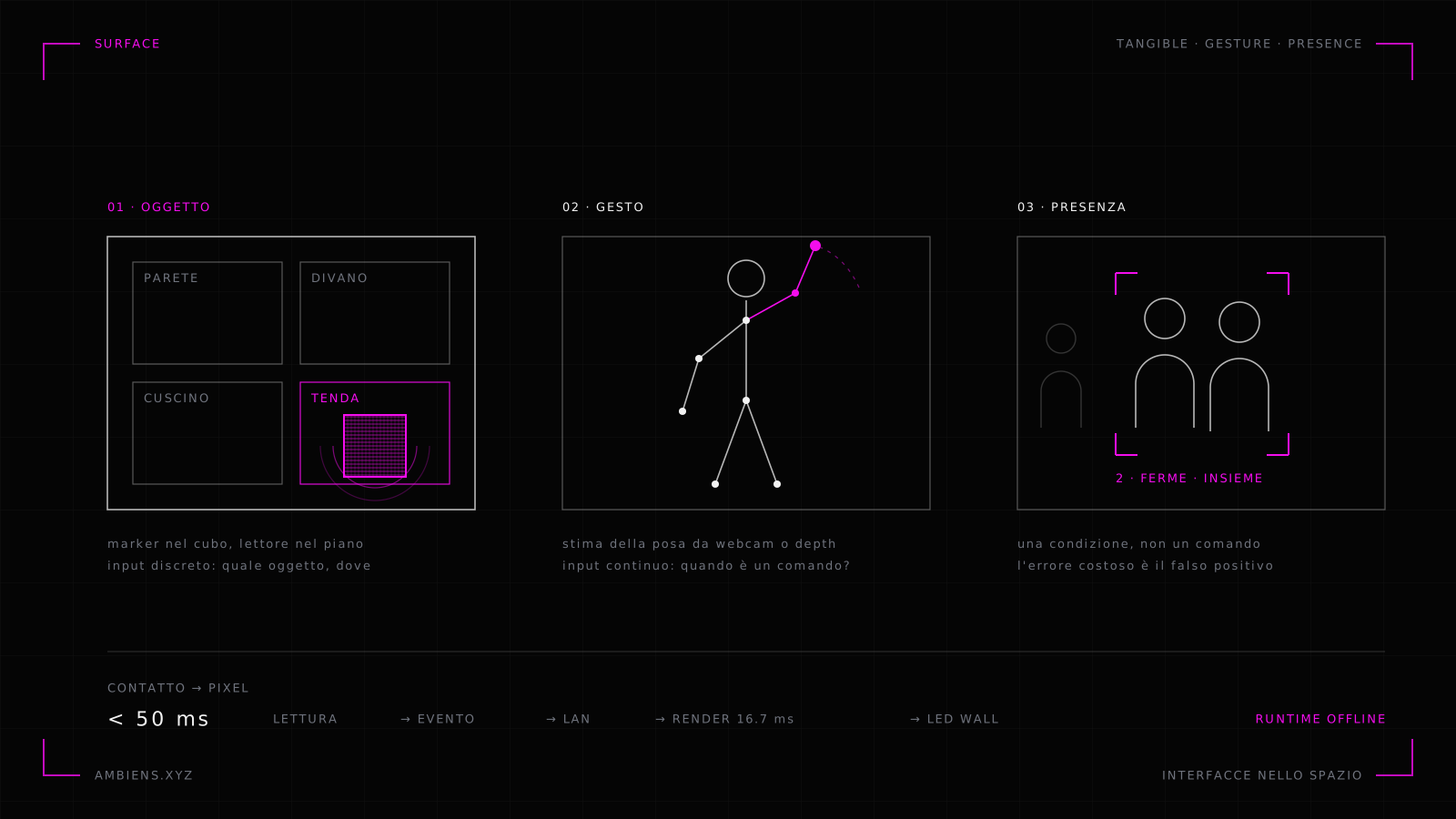
The object. The visitor picks something up and puts it down somewhere. That's the Phygimat we built for C&C Milano and the token-on-a-map table in Avezzano che fu. The input is discrete: there's an object, there's a slot, and the system only has to work out which one and where.
The gesture. The visitor moves hands, head or body in front of a camera. That's Body Control, our tracking system: it reads movement from a regular webcam or a depth camera and turns it into commands. Here the input is continuous, and noisy by nature.
The presence. The system doesn't wait for a command, it watches for a condition. For the Durex street activation in Milan the condition was two people, standing still together, in front of the kiosk. When that's true, the LED wall starts.
The distinction matters because each one fails differently. Objects rarely fail, and when they do it's because the table didn't read them. Gestures fail often and in small ways: jitter, one hand mistaken for another. Presence fails big, because a false positive starts the experience for someone who was just walking past.
Fifty milliseconds, contact to pixel
On the Phygimat, less than 50 milliseconds pass between the cube touching the table and the fabric changing on the LED wall. The threshold has a perceptual reason. Below 50 ms, people read cause and effect as a single action. Above it, they start noticing a system that responds, and the system stops being transparent.
Those 50 ms are spread along a whole chain. The reader built into the tabletop recognizes the marker inside the cube. The application turns "this cube on this slot" into a material change. The command travels over the local network to the scene PC, where the Unreal Engine scene swaps the material and redraws it with real-time lighting. At 60 fps a frame lasts 16.7 ms, so rendering alone eats one or two frames of the budget. Then the signal enters the LED wall's processor, which adds its own delay and which we don't control: the LED wall came from another supplier.
Two working rules follow. Measure every link separately, because "it's slow" doesn't tell you where. And keep everything you can local: the Phygimat runtime doesn't need the internet. The same goes, for even stronger reasons, for Durex, where face tracking and depth estimation run on the GPU of the iPad inside the kiosk, with no cloud involved.
The budget depends on what the action asks for. On the Avezzano map, the token opens a reconstruction of one district as it stood before the 1915 earthquake, and the response there sits under 100 ms. Someone moving a token on a map is looking something up, and in our experience can afford a beat more than someone assembling a room piece by piece. At the C&C table visitors try one combination after another, and every hesitation breaks their train of thought.
Reading an object
There are several ways to recognize an object on a surface, and each has a cost. A radio tag (NFC or RFID) reads at a few centimeters, through the material, without needing to see it. An optical marker read by a camera wants line of sight and controlled lighting, neither of which you can count on in a booth full of projectors and people leaning in. A capacitive surface knows where something is but struggles to tell which thing it is.
In the C&C cubes the marker sits inside, out of sight. That's more than an aesthetic call: the whole surface of the cube is the real fabric, and the real fabric is the point. Visitors touch the linen before they see it applied, and that changes how they judge it. A cube with a code printed on it would be a game controller in costume.
The cube cores come out of our Fabrication Lab, 3D printed in filament or resin depending on the part. It sounds like a production detail, but it settles the most important thing about a tangible interface: the object has to explain itself. Shape, weight and size say "pick me up and put me down". Squares labeled "wall", "sofa", "curtain" and "cushion" say where.
The rest is state logic, and that's where the bugs hide. What happens when a cube is lifted off? Does the fabric stay, or revert? If two cubes land on the same square, does the last one win? A touchscreen answers these questions with its own grammar: one touch at a time, a button to undo. A table with six people around it has no such grammar, so you write it out in full before you open the editor.
Reading a body
With gestures the problem flips. The object is always there and only needs identifying; the body is always moving, and the hard part is deciding when a movement is a command.
Body Control works on pose estimation: from each frame it extracts the body's keypoints (hands, head, shoulders), and commands come from how those points move. The two public demos show it well. In Neon Bubble Pop you pop bubbles by moving your hands in front of the webcam; in Feed the Face you play with your head. Both run in the browser, so anyone can judge the lag on their own laptop.
The most interesting design problem, though, is presence. For Durex, recognition had to fire on exactly two people standing still together in front of the kiosk. Every word in that sentence is a filter against a false positive. "Two" rules out the lone passer-by and the group. "Standing still" rules out anyone walking. "Together" rules out two strangers who happen to be there. In a street installation, the trigger condition is half the design. The other half (a short game on the LED wall, streamed over Teradek, and a gift from the brand ambassadors) only works if it fires for the right people.
There was also a constraint you don't get in a booth: no power and no network. A battery kiosk that lasts a full day, processing on the device, a cable-free LED wall. It's the latency rule taken to its limit. Anything that doesn't depend on an outside service can't stop working because of one.
What changes for the designer
Put side by side, the three cases say a few things that hold whatever the sensor.
Every action needs a visible response within budget, even when the response is "I didn't get that". A table that ignores a badly placed cube looks broken, and the visitor walks away.
Several people share one interface. On the Phygimat people compose in groups, on the Avezzano map they pass the token around, and the Durex kiosk needs two people by definition. Shared state has to be designed: who gets the last word, what someone arriving halfway through sees.
Accessibility gains from it. When information travels through touch and handling, the experience depends less on sight and on fingertip precision on glass. For C&C and Avezzano we designed against WCAG 2.1 AA and the European EN 301 549 standard: large drop zones, no fine gestures required, the same information over more than one channel. Touchless gesture input, in turn, gives an alternative to people who can't use touch or controllers.
Finally, the runtime has to survive the build-up. The Phygimat sets up in a day and runs offline, because at a trade show nobody has time for an update that starts when the doors open.
Where XR comes in
In all three cases the object or gesture is the way in, and what opens on the other side is a 3D environment. At C&C it's the Via Brera apartment rebuilt in Unreal Engine with physically based materials, so the fabric on the cube and the fabric on the LED wall look like the same thing. In Avezzano the token on the map opens the same reconstruction of the city that visitors to the Aia dei Musei can also walk through in a headset, and that the AR app overlays on today's buildings in Piazza San Bartolomeo.
That's what we mean by space as the interface. The hand stays in the physical world, where it already knows what to do, and the digital environment answers at the same speed. When the chain holds, from sensor to pixel, visitors stop noticing the sensor and look at the fabric.
We design and build interactive installations under Surface: the Phygimat, Body Control, the C&C Milano case, or get in touch.