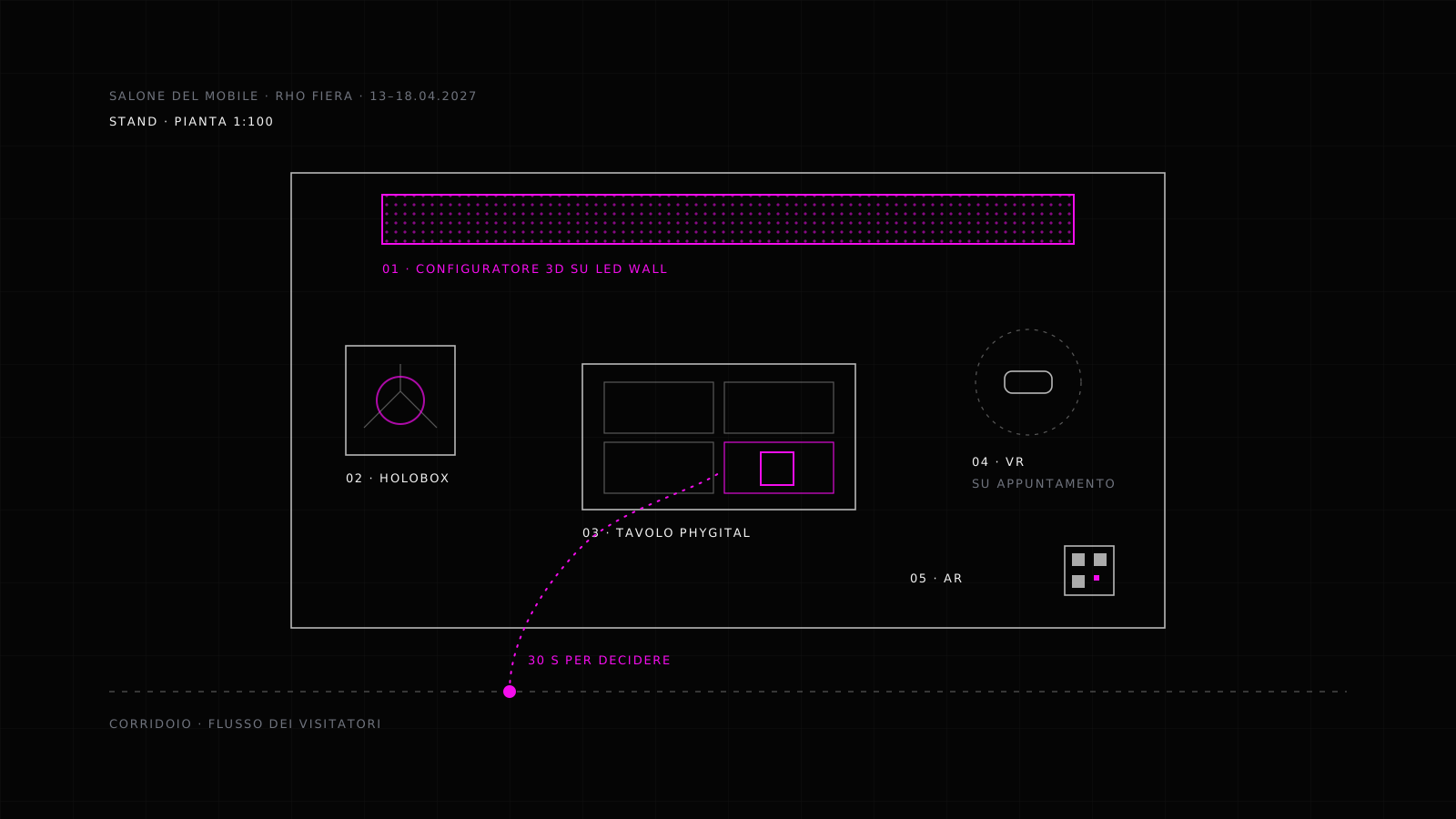
Salone del Mobile 2027 opens on April 13 at Rho Fiera Milano and closes on the 18th. For exhibitors, the game is played in the few seconds a visitor spends walking past the booth and deciding whether to step in. In those seconds they need to understand what you do and find a reason to stop, while hundreds of other booths around them are trying to do the same.
XR installations (real-time 3D configurators, augmented and virtual reality, physical objects that drive digital content) exist to give them that reason. They work when they are designed for trade fair conditions, which are very different from a showroom's. Below are the formats we use most often in booths, where each one breaks down, and what drives the timeline for being ready in April.
What we mean by an XR installation at a trade fair
XR (extended reality) is the umbrella term for augmented, virtual and mixed reality. In a booth, though, the technology that works best often doesn't ask anyone to wear anything: it's a real-time 3D scene on a large screen, which the visitor controls with a touch, a gesture or an object. So we use a broad definition: an XR installation is 3D content that responds to what the visitor does, while they do it.
A looping video is something you watch in passing. An installation asks the visitor for a choice (a finish, a variant, a point of view) and shows them the result, and that choice is what keeps them in the booth.
Five formats that work in a booth
The 3D configurator on an LED wall
The product, or a whole room, rebuilt in photorealistic 3D and shown on an LED wall or a large screen. The visitor changes finishes, colors and variants from a touchscreen or a tablet, and sees the result at scale, with correct lighting.
It works when the collection is bigger than the booth: twenty finishes, three sizes, custom variants. Instead of bringing them all, you bring a few and the scene shows the rest. The delicate part is material quality: if the wood on screen doesn't look like the sample half a meter away, the comparison works against you.
The holographic case (Holobox)
A glass case in which the product seems to float in midair and slowly rotate. Behind it there is a 3D application on a touchscreen, a semi-transparent panel and lights tuned for the illusion. Touching the glass, visitors pick a product, rotate it and open it up.
It's the most photographed of the five, and it works well for technical products that say little in person: a mechanism, a component, the inside of an object.
The phygital table
Physical objects (cubes, discs, samples) covered in the brand's materials, which change a 3D scene on screen when placed on a table. The visitor touches the fabric or the stone before seeing it applied to a sofa or a wall.
It's the best fit for brands that sell materials: fabrics, surfaces, ceramics, woods, finishes. There's no interface to learn, and several people can use it at once. We wrote about it in more depth in When space becomes the interface.
The VR headset
A headset that takes the visitor inside a complete environment: a furnished hotel, an office, a factory. It's the only format that gives the true scale of a space, and it's valuable for contract and for anyone who sells projects rather than objects.
Its limit at a fair is pace: one person at a time, a few minutes each, a staff member who helps put the headset on and cleans it between visitors. That's why it's best kept for buyer appointments, leaving passing traffic to other formats. Used this way it can carry a lot of weight: for Emmepi, the virtual factory they brought to a trade fair coincided with a 40% increase in qualified quote requests compared with previous events.
Augmented reality on the phone
The visitor scans a code and the product appears at real scale on their phone, in the booth or, more usefully, at home or in the office after the fair. No hardware is needed in the booth, and contact with the product continues after Salone is over.
On its own it holds attention poorly, because at a fair people use their phones on the move. It works better as the tail end of another format: you saw the finish on the LED wall, now you take it home.
What changes at a fair compared with a showroom
The same technologies that run smoothly in a showroom have to cope with different conditions at a fair. Those conditions decide whether an installation works on day six as well as on day one.
The network isn't guaranteed. The fair's wifi, with thousands of devices connected, is unreliable. The installation should run entirely offline and use the internet only for secondary features, such as sending a contact.
Traffic is uneven. There are empty hours and hours when a queue forms in front of the booth. A three-minute experience for one person at a time creates waiting; one that works in thirty seconds and takes several people at once doesn't.
Setup is tight. The booth is built in a few days, with other suppliers working in the same space. Hardware, calibration and content have to be tested beforehand, in the lab, so that at the fair all that's left is to connect and check.
You need a plan for when something breaks: a spare PC, a copy of the content, someone reachable during opening days.
And the content can live beyond the fair. The 3D scenes built for the booth can be reused for social media, the website, the showroom and the sales network. With Surteco, for example, the 3D rooms end up in the hands of salespeople, in VR and AR, across all their markets.
What drives the timeline
The timeline depends more on the starting point than on the technology. A format that already exists and only needs adapting to the brand, like the phygital table, takes much less than a fully custom installation. Either way, the installation has to be tested in the lab before it reaches the fair, and that step belongs in the schedule like every other. The earlier the conversation starts, the more room there is for testing.
What slows things down most is almost always upstream: 3D models of the products (if CAD files exist we start from those, otherwise the products are modeled or scanned), samples of the materials to reproduce, and decisions on the booth design, which fixes the size and position of the screens.
Two projects from our work
Geberit at Salone del Mobile: 3D video and Holobox
Geberit needed to stand out at Salone with bathroom products that are technical by nature: concealed cisterns, mechanisms, ceramics. We built two formats that complement each other. Photorealistic 3D product videos, rendered in Blender with water flow simulations, open up the mechanisms and show the materials on the booth's large screens. The Holobox, a Unity application with a touchscreen, makes the products float in a glass case: visitors pick them, rotate them, compare finishes and variants, and open the specs.
The Holobox was one of the most photographed spots in the booth. Having two different reasons to stop, one to watch and one to touch, kept people in the booth far longer than a traditional setup. The full project.
C&C Milano at Milan Design Week: an apartment that changes fabric
For C&C Milano, a high-end Italian textile brand, the 2026 Design Week brief held a contradiction: telling the story of fabrics you understand by touching them, inside a technological installation. We rebuilt the brand's historic apartment in photorealistic 3D on an LED wall and placed a phygital table in front of it, with cubes covered in the atelier's fabrics. The visitor sets a cube on the "curtain" or "sofa" square and the fabric appears on the matching surface, at real scale, in under 50 milliseconds.
People stayed in the booth far longer than average, composed their own version of the apartment and left knowing how those fabrics look in a room. The full project.
What to prepare for the brief
If you're considering an installation for April, this information shortens the first round considerably:
- what the visitor should understand in thirty seconds, in one sentence;
- which products or materials to involve, and whether CAD files exist;
- the booth floor plan, even a provisional one, with dimensions;
- who you'll be talking to: passing traffic, buyers by appointment, or both;
- whether the content needs to work after the fair too, and where.
If you're preparing your booth for Salone, write to us with these five answers, even incomplete ones: we start from there, and the right format often becomes clear at the first meeting.